The economy matters to a property owner through people, businesses, credit and the built environment. Understanding those connections is more useful than treating every positive national announcement as a reason to buy.
This section helps you decide which economic changes deserve attention for your particular investment horizon. It brings together market research and the practical questions that turn a broad outlook into a property strategy.
An economy, a building and an owner run on different clocks
An investor who needs a usable property soon faces a different problem from someone considering a future development. The first decision is shaped by homes available today and the circumstances of their occupants. The second includes the neighbourhood and competing buildings that may exist later. A long-term economic ambition can be relevant to both, but it cannot remove a near-term requirement for access, income or a particular completion date.
Place your intended ownership period beside the developments being discussed. Identify what must already work, what could improve during your ownership and what may occur after your likely exit. This reveals when an attractive national story is being used to justify paying now for a benefit you might never experience. You can remain interested in that story while assigning it an appropriately limited role in the purchase.

Follow the household behind the demand story
Business expansion becomes relevant to housing when it changes where people need to live, what they can afford and how long they expect to stay. Those links are not identical for a household relocating permanently, a professional on a shorter assignment or a family maintaining a second base. Start by identifying the potential occupier rather than assuming that growth benefits every property format equally.
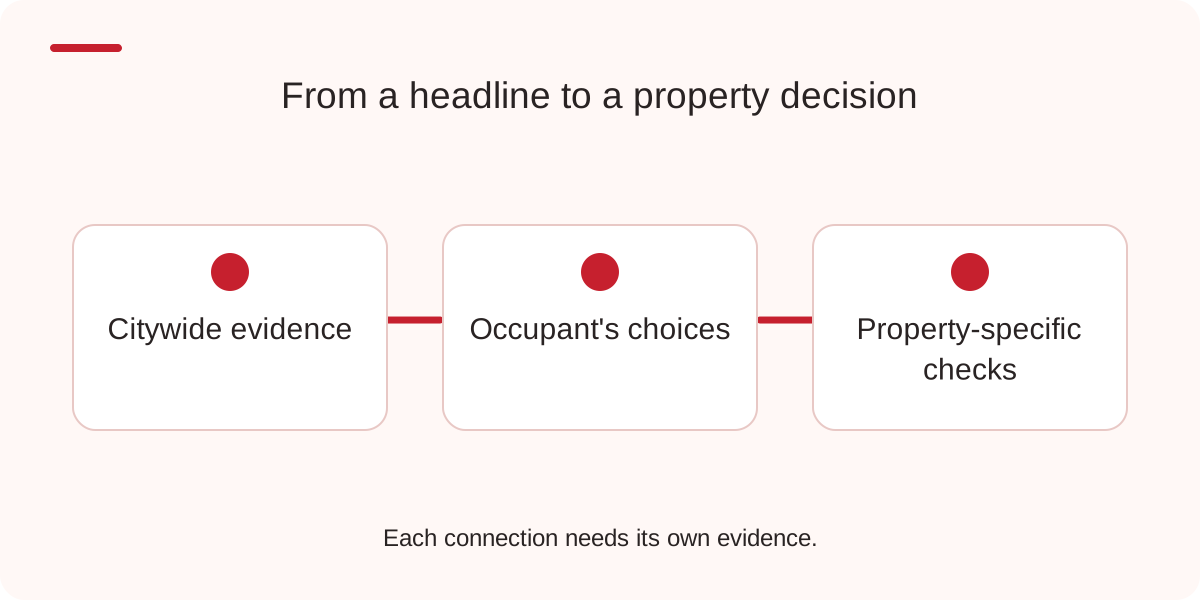
The questions then become concrete. Does the home accommodate the household's routine? Are the alternatives materially different in total cost or convenience? Would the same occupier still consider it if their workplace or travel pattern changed? Research into schools, employment destinations and transport can inform these questions, but each connection needs its own geographical evidence. An employer announcement elsewhere in an emirate does not establish demand at the front door of a particular building.
Visitors support a different set of investment questions
A visitor-led proposition has different dependencies from a home intended for a continuing household. The appeal may involve the purpose of a trip, the accommodation alternatives, the length of stay and the practical experience of arriving at the property. General destination awareness is only one part of that proposition; it does not establish bookings for an individual address.
Explore how the investment would operate if the expected visitor pattern changed. A unit chosen mainly for short stays may require active service, replacement spending and a suitable operator. Personal use can also compete with the periods when you hoped to earn income. Before preferring that model, verify its permitted operation and consider whether another lawful use is practical. A tourism narrative becomes commercially useful when it leads to these operational questions, not when it is treated as an occupancy forecast.
Financial conditions can reach the owner through several routes
The cost and availability of money can affect your own funding, other buyers' purchasing capacity and the alternatives competing for your capital. A buyer using cash still has decisions about liquidity and other potential uses of that cash. A borrower must examine the actual financing agreement rather than assuming a headline policy announcement changes every repayment immediately.
CBUAE's monetary-policy pages provide an official starting point for researching the UAE framework and benchmark rates. Your application of that context should remain specific: which contractual rate or condition affects this investment, when can it change, and what choice would follow? For an overseas owner, also consider the currency in which other commitments must be paid. A satisfactory result measured in dirhams may serve a different purpose from the amount ultimately available for spending elsewhere.
Physical development changes places unevenly
Infrastructure and new districts can alter accessibility, the choice of homes and the daily experience of an area. Their influence depends on the project, its stage and the relationship to the property. A new destination may bring amenities while also changing traffic or increasing competing accommodation. Those effects can occur at different times and may matter differently to residents and visitors.
Consider the period of transition as well as the proposed finished setting. Construction around a home, incomplete services or changing access arrangements can affect its usefulness before a broader plan is realised. This does not make emerging districts unsuitable; it changes the terms of the evaluation. Decide which temporary conditions you could accept and which would conflict with the property's job. Avoid paying for a completed lifestyle while budgeting only for the purchase of an unfinished environment.

Match your next research step to the uncertainty
Different uncertainties call for different work. If the concern is the strength of a broad market narrative, use the market-indicator resources to inspect the evidence and its scope. If the concern is which district serves a particular occupier, move to location research. If the same property looks affordable or expensive depending on borrowing, work through the finance assumptions before collecting another set of neighbourhood photographs.
Finish the economic review with a small set of dependencies you can describe in ordinary language. Perhaps the strategy needs a stable household use, acceptable refinancing terms or a district improvement within your ownership horizon. State what would make each dependency less convincing. That gives future news a purpose: it can confirm, challenge or leave unchanged the relevant part of the strategy, instead of prompting an entirely new investment opinion every week.
Sources & further reference
- Central Bank of the UAE — Monetary Policy and Domestic Markets Checked 2026-10-08
- ADREC — Official Market Reports Checked 2026-10-08