Due diligence is the work of finding out what a property commitment actually involves. It connects the asset described in an advertisement with its ownership record, condition, contractual obligations and permitted use. A polished presentation can begin that investigation, but the investor still needs to understand which statements are established and which remain assumptions.
This section explains how to organise that judgement across a UAE property search. Registration procedures and applicable requirements depend on the emirate and transaction. Official Dubai services mentioned here illustrate specific verification routes; they are not a single rulebook for every property in the country.
What can this particular source establish?
Begin with the question you need answered, then choose evidence capable of answering it. A title record, a technical inspection, a signed specification and a current quotation have different purposes. A photograph may show a visible feature without establishing who owns it or whether it is included in the agreement. A company biography may explain a business background without demonstrating the delivery history of the legal entity selling your unit.
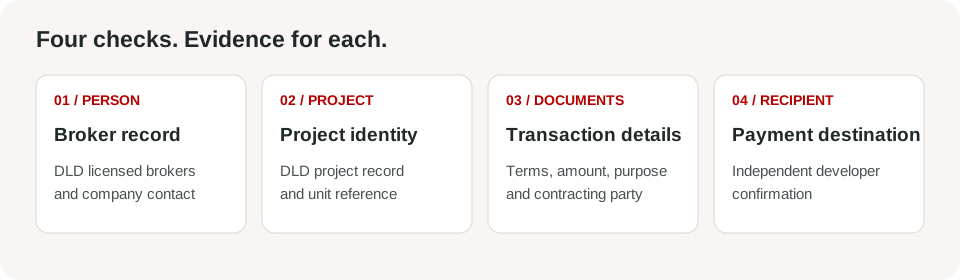
Ask where the information originated, when it was produced and whether it concerns the exact property. Several websites repeating the same brochure are not several independent confirmations. A forwarded screenshot can be useful as a lead, but its age and context may be unclear. Where an official verification service exists, use it for the question within its scope. DLD's title-deed verification is one Dubai example; it does not replace a condition inspection or a contract review.
When two documents describe the property differently
Conflicting information deserves a written explanation before it becomes part of the purchase calculation. An advertisement might use one area figure while another document uses a different measurement basis. The first task is to establish what each number describes, rather than deciding that the larger figure is more attractive or the smaller one is necessarily correct. Identify the document governing the relevant transaction point with the appropriate professional.
Keep the discrepancy visible until it is resolved. Record the competing descriptions, who supplied them and the response that reconciles them. If the explanation changes the usable layout, included items or total price, revisit the commercial comparison as well. A corrected document can affect more than an administrative detail. Conversely, a difference caused by an understood measurement convention should not be presented as a discovered defect without evidence for that conclusion.

A missing answer does not always carry the same weight
Sort open questions by the decision they could change. Uncertainty about the seller's authority has a different consequence from uncertainty about the colour of a movable furnishing. An unknown repair cost may be manageable once inspected and priced, while an intended use that cannot be established may undermine the entire investment case. The amount of paperwork is a poor measure of importance; focus on the effect of the unanswered question.
Consider when the uncertainty must be resolved and how reversible the next action is. Before making a commitment, obtain advice on the obligations that action creates and the conditions for leaving it. Do not assume an internal decision to pause overrides signed terms. Where the issue remains material, delaying or declining the proposal may be more appropriate than treating a promising explanation as a completed verification. Record the reason so later enthusiasm does not erase it.
Different kinds of risk need different expertise
Commercial, legal, technical and financing questions overlap, but they are not interchangeable. An adviser may identify a price comparison, an inspector may explain a visible defect, and a legal professional may interpret the proposed obligations. Ask each person to state the scope of their work and the matters excluded. A confident answer outside that scope should become a referral question, rather than gaining authority because the person was helpful on another subject.
Understand who engaged the professional and any relevant relationship with the transaction. Request supporting reasoning when a recommendation affects your commitment. Independence is useful when it brings a separate assessment of an important issue; adding more participants without defined responsibilities can merely create conflicting instructions. For Dubai off-plan research, the DLD project-status service offers project and escrow information, while the unit agreement still needs its own review. Neither process supplies a blanket judgement that an investment is suitable.

Preserve the explanation, not just the attachments
Keep a concise account of the significant questions, the evidence considered and the conclusions reached. Attach the relevant version of a document and the date of review. If terms change, identify which earlier conclusion needs reconsideration. This is more useful than an archive containing several near-identical agreements without an indication of which one supported the decision. It also helps a new adviser understand the file without rebuilding the entire investigation.
The next stage is to connect those findings to the investor's actual authority and financial commitment. Our acquisition guide develops that decision record, while the overseas-investor section explains how to coordinate people and records across borders. Carry unresolved operating matters forward after purchase with a named owner. Due diligence has done useful work when it improves both the commitment being made and the practical understanding of the asset that will need to be owned.
Sources & further reference
- Dubai Land Department — Verify Title Deed Checked 2026-10-08
- Dubai Land Department — Project Status Enquiry Checked 2026-10-08