When a bank valuation comes below your agreed purchase price, the immediate question is how much money must come from you. Start with the lender’s revised funding figure, subtract it from the price, then add the costs still payable. Compare that total with money available by completion, while protecting the reserve you need afterwards. A lower valuation can change the purchase even when the seller’s price and your income have stayed exactly the same.
This guide concerns a financed purchase of an existing Dubai property after you have identified a particular unit. Its worked figures are invented to explain the calculation. They are not lending limits, a bank offer or a valuation of any property. Ask your lender to confirm the value it uses, the financing amount and the remaining conditions for your case. The useful result is a revised cash schedule that you can discuss with the seller and the professionals handling the transaction.
Separate the price, valuation and available loan
The asking price is the seller’s starting position; the agreed price belongs to your transaction. The lender’s accepted property value serves another purpose in its financing assessment. None of these amounts should silently replace another in your spreadsheet. Emirates NBD’s home-loan Key Facts Statement describes valuation as an independent assessment of market value. A valuation figure also does not answer every question about defects, maintenance or whether the layout suits your household. Keep any technical inspection and your own buying assessment separate.
Write the three figures on different lines and attach the relevant document to each. If the bank communicates only an estimated loan, label it estimated and record what could change it. HSBC UAE explains that approval in principle indicates possible borrowing and does not guarantee a home loan. For the earlier application stage, use our mortgage preparation guide. Here, the focus is the amount the lender will actually make available for this purchase and the conditions that still stand between the current indication and that payment.
A worked cash-gap example
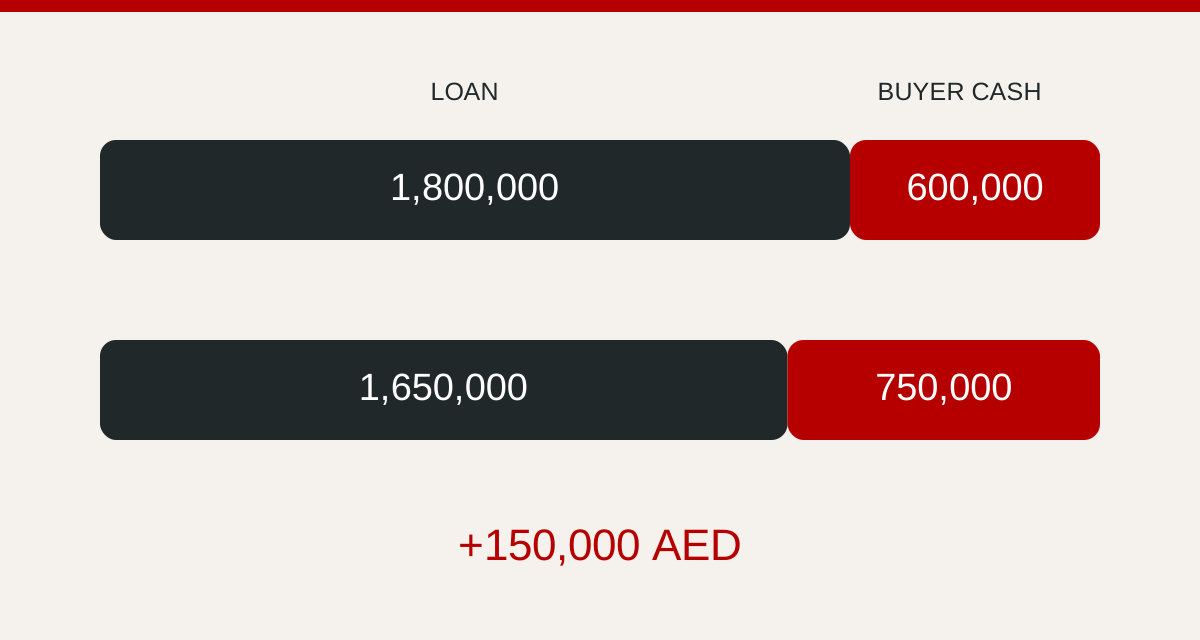
Suppose the agreed price is AED 2,400,000. For this example only, assume the lender would calculate financing at 75% of an accepted value of AED 2,400,000, with no other restriction reducing that result. The illustrative loan is AED 1,800,000 and your contribution towards the price is AED 600,000. The percentage is a chosen teaching assumption. It must not be read as the percentage available to a resident, an overseas buyer or a particular property type.
Now suppose the accepted value is AED 2,200,000 and the same assumed calculation applies. The illustrative loan becomes AED 1,650,000. Because the agreed price remains AED 2,400,000, your contribution becomes AED 750,000. The additional cash is AED 150,000. Notice that the valuation fell by AED 200,000, while the loan fell by AED 150,000. Mixing those two differences would overstate the extra money needed in this example. Fees, insurance and your post-purchase reserve have not yet been included in either contribution.
| Item | First assumption | Lower accepted value |
|---|---|---|
| Agreed price | 2,400,000 | 2,400,000 |
| Accepted value | 2,400,000 | 2,200,000 |
| Assumed loan | 1,800,000 | 1,650,000 |
| Buyer contribution towards price | 600,000 | 750,000 |
Check which limit actually controls the loan
A lower property value does not always reduce borrowing by the same proportion. Imagine that a separate borrower assessment already limits the loan in the example to AED 1,600,000. That amount is below both illustrative property-based calculations, AED 1,800,000 and AED 1,650,000. If every other condition remains unchanged, the lower valuation alone does not alter the loan in that scenario. Your contribution towards the price remains AED 800,000. This is why a percentage calculator cannot replace the lender’s written assessment.
Ask which factor is controlling the offered amount: the accepted property value, your assessed circumstances, the requested loan, or another product condition. Ask for the revised amount in dirhams, not just a percentage mentioned in a conversation. If the amount changes, request the reason and an updated repayment illustration. A smaller loan may lower repayments while increasing the cash needed now; neither result makes the whole purchase automatically affordable. Examine the immediate funding problem and the continuing commitment together before deciding what to do next.
Build the remaining-payment ledger
Separate the total contribution towards the price from the amount still to be paid. In the lower-valuation example, AED 750,000 must come from the buyer towards the price. If AED 100,000 has already been paid and is documented as credited against that price, the remaining price contribution is AED 650,000. Do not deduct a sum merely because someone calls it a deposit. Establish whether it has actually been paid, where it is held and how the completion statement treats it. A security cheque and an acknowledged payment are not interchangeable entries.
Next add each separate cost that remains due, using current written figures for your transaction. Record the recipient, payment date and whether the sum has already been paid. Keep purchase-price payments, lender charges and transaction costs in separate columns so the same receipt is not counted twice. A quote for a service is not proof of payment. If a charge is unresolved, show a clearly marked estimate or unanswered question. Entering zero would make the available balance look stronger than the evidence supports.

Count money available on the required date
A savings balance can be different from usable completion money. Some funds may sit in a term account, be committed to another payment or depend on selling an asset. Record each source and when it can reach the required account through the appropriate verified channel. If money will arrive from abroad, ask your banks about documentation and transfer arrangements before building a timetable around it. This is a planning question; a general transfer estimate does not establish when your particular payment will clear.
Use the currency in which the obligation must be met when comparing funding sources. If your savings are in another currency, obtain a current conversion and transfer-cost estimate rather than treating the account balance as a fixed dirham amount. Keep a margin chosen for your circumstances and discuss uncertain sources with your lender. Do not conceal additional borrowing or assume a short-term loan is an acceptable way to cover the gap. Any change to liabilities can matter to the financing assessment and should be disclosed through the proper application process.
Protect the money needed after completion
Decide what must remain available after the purchase before offering to fill the entire gap from savings. For an owner-occupier, that may include moving, essential repairs and ordinary household commitments. For an investor, distinguish acquisition cash from money intended for vacancy, maintenance and ongoing property expenses. Use your own needs and actual property information; this guide does not prescribe a universal reserve. The objective is to see whether the revised purchase leaves you able to use and maintain the property without depending on an immediate favourable event.
Put the protected reserve on a separate line instead of hiding it inside a generous-looking cash balance. Then compare two outcomes: completing at the current price with the revised loan, and keeping that reserve intact. If those outcomes cannot coexist, the purchase structure needs another discussion. A lower monthly repayment does not replace cash already committed to living costs. Nor should expected rental income, a future bonus or an assumed resale gain be treated as money already available for completion. Test the purchase against resources you can substantiate.
Check the report’s factual inputs before disputing its conclusion
Start by confirming that the valuation concerns the correct unit and the correct documents. Ask the lender or appointed professional how to raise a factual issue, such as a mistaken unit identifier or an area description that does not match the supplied record. Provide the underlying document and identify the precise point you believe needs checking. Do not alter documents or describe an unverified feature as an established inclusion. A clear correction request is more useful than a broad assertion that the property ought to be worth more.
Ask whether a review is available, who can request it, whether there is a charge and what effect it might have on the timetable. Availability and outcome are not guaranteed. Do not assume that paying for another valuation means the current lender will accept it. Comparable asking prices can help frame a question but do not by themselves prove a completed transaction value. Our pricing evidence guide explains how to assess comparisons. The lender must explain the evidence it can consider in your actual case.
Take a revised proposal to the seller
A lower lender valuation does not automatically change the agreed sale price. If you want to discuss a reduction, make the revised proposal explicit: the proposed price, the funding position and the completion arrangements you can support. Ask the transaction professional how that proposal relates to existing commitments. Keep the conversation focused on a feasible purchase rather than presenting the valuation as a legal entitlement to a discount. The seller may accept, reject or counter the proposal; your budget should not presume a particular response.
Recalculate the funding structure if the price changes. Do not simply subtract a proposed discount from the old cash gap and assume the loan stays fixed. The lender may need to reassess the figures using the revised transaction details. Obtain the updated amount and record any remaining conditions before treating the new proposal as funded. If an agreement is reached, have the appropriate documents reflect it through the professionals handling the sale. The spreadsheet is a decision aid, not a substitute for the signed terms or the lender’s requirements.
Compare practical options without rushing the financing
There are several discussions you can have when the revised cash requirement is uncomfortable: contribute more of your own available money, seek a different price, explore another financing proposal, or reconsider the purchase within your contractual position. Each option has different consequences. Additional cash reduces the reserve; another lender brings a new assessment; a revised price needs agreement. Obtain actual figures and timelines before describing any option as a solution. A headline percentage from another bank is not confirmation that it will finance the same unit on that basis.
Compare the complete proposed arrangement if you explore a different lender. Include the cash required at completion, repayment structure, charges already incurred, new charges, outstanding conditions and the time needed for the process. Ask what existing reports or documents can be reused instead of assuming portability. Avoid paying for several applications without understanding their cost and purpose. If none of the verified options fits your resources and deadlines, seek advice on the contractual choices available. Do not let money already spent become the sole reason for accepting a larger commitment than you can sustain.
Keep contractual dates visible while the bank reviews
Place the lender’s outstanding steps beside the dates in your transaction documents. Identify who must supply the next item and when a response is needed for the purchase to remain workable. An expected bank response date is not an agreed extension with the seller. If more time may be required, raise the issue early with the professionals handling both sides and establish what must be documented. Avoid relying on a casual message that everyone will be flexible when the actual obligation is set out elsewhere.
Do not assume that a low valuation allows you to cancel without cost or guarantees the return of a deposit. The consequences depend on the actual agreement and applicable circumstances. Have a qualified legal professional explain any financing condition, notice requirement, deadline or proposed variation before relying on it. Keep the valuation and revised funding communications with the transaction file so the advice is based on the real documents. For the wider paperwork sequence, consult our transfer document checklist, while obtaining transaction-specific answers from those responsible for the purchase.
Reconcile the final figure before arranging payment
Ask the lender to identify the amount intended for the purchase, any deductions or separately payable charges, the recipient arrangements and outstanding release conditions. Compare that confirmation with the completion statement rather than relying on the largest number appearing in a loan illustration. Ensure the buyer contribution and the lender funds together cover the documented price allocation. Where an existing seller mortgage or another transaction dependency is involved, let the responsible professionals explain the payment sequence and incorporate it into the dated schedule.
Verify payment instructions using established channels, especially if an account or recipient suddenly changes. Retain confirmations and receipts, then mark the matching ledger line as paid. After any revision, date the schedule and retain the earlier version so the reason for a changed cash requirement remains clear. The last useful check is simple: price funding, separate unpaid costs, timing and protected reserve should reconcile to the same version of the transaction. If they do not, resolve the difference before treating the purchase as ready to complete.
Questions to resolve in writing
- Which property value and which other conditions determine the revised loan amount?
- What sum remains payable towards the price after documented credits?
- Which costs are unpaid, and who must receive each payment?
- What resources can be available by the required date without consuming the protected reserve?
- What contractual action is needed if financing or timing changes?
Bring those answers, the selected unit and your revised cash schedule to a PGI consultation to discuss a property search that reflects the funding position you can support. If the transaction is no longer suitable, the same schedule can help narrow the next shortlist. A useful outcome is not simply obtaining a higher loan or persuading a seller to reduce a price. It is reaching a documented purchase structure that fits your available resources, responsibilities and intended use of the property.
Primary sources and scope
The official sources below were checked on 12 October 2026. HSBC UAE supports the distinction between initial approval and a guaranteed loan. Emirates NBD supports the role of valuation; its indicative Key Facts Statement is not used here as a current product quote. All scenario figures and the payment ledger are explanatory examples. Current eligibility, pricing, fees and the conditions for releasing funds must be confirmed for the borrower, the lender and the specific property involved.