

An apartment search in Jumeirah Lakes Towers should begin with the tower's exact position and the way its residents reach everyday destinations. A lake outlook, a convenient office journey and a comfortable layout can all contribute to a good purchase, but they are separate benefits. The JLT name alone does not tell you which combination an individual home provides.
This JLT apartment buyer guide focuses on tower selection, walking routes, parking, building operations and a realistic ownership budget. It is useful for someone buying a home to live in and for a landlord trying to understand the intended tenant. The aim is to move from a broad community preference to a shortlist of specific apartments whose advantages and limitations can be checked in person.
What this guide covers
• Understand JLT without treating every tower as equivalent
• Plan the walking journey from the front door
• Assess the cluster's vehicle access
• Compare lake views with privacy and orientation

KINGDOM BY MAG "MBL Signature" catalogue image in Jumeirah Lakes Towers. Project marketing illustration; confirm the exact home's condition, specification and availability separately.
Understand JLT without treating every tower as equivalent
The official JLT community website identifies Jumeirah Lakes Towers as a community developed and managed by DMCC. It provides a starting point for understanding the area's community identity and resident information. Buyers should then investigate the individual tower, since building management, internal layouts and access arrangements need property-specific confirmation.
Record both the tower name and cluster when organising your search. Verify the entrance shown on the map and identify the actual route used by residents and vehicles. A general address in JLT does not establish how someone gets from an apartment to work, a shop or public transport.
Separate the master community from the apartment building in your notes. Ask who manages the building, who deals with common-area issues and where residents obtain relevant guidance. This prevents an enquiry about a private tower's lifts or charges from being answered only with broad information about the surrounding district.
Plan the walking journey from the front door
A useful walking assessment starts inside the tower. Include the lift journey, the building exit, the pavement route and any crossings or level changes. If your destination is a station, walk to the entrance you would actually use rather than measuring a straight line from the tower's map pin.
Check the route with the intended user in mind. Someone carrying a laptop bag may judge a path differently from a parent with a stroller or a resident with reduced mobility. Look for continuous access, useful lighting and places where a route becomes awkward. The question is whether the journey is practical repeatedly, not whether it is technically possible once.
For current public transport options, consult the RTA S'hail information and journey planner. Confirm connections and timing for your own destination. Being in a district associated with public transport does not mean every apartment offers an equally convenient door-to-door journey.
Assess the cluster's vehicle access
Before concentrating on the apartment, drive to the building and locate its resident entrance. Identify the route into and out of the parking area, including any turns that are easy to overlook on a map. A convenient approach from one direction may be less straightforward on the return journey.
Inspect the allocated bay if access is available. Check dimensions, pillars, ramp clearance and manoeuvring space when surrounding bays are occupied. Ask how the allocation is documented and whether the advertised number of spaces matches the proposed purchase. Do not rely on a photograph of an empty garage to answer these questions.
Explore visitor arrangements as well. Guests, tradespeople and delivery drivers may use a different entrance or parking process. For buyers who host frequently or landlords who need repair access, that difference has practical importance. Keep the answers alongside the apartment details so they influence the comparison before an offer is made.
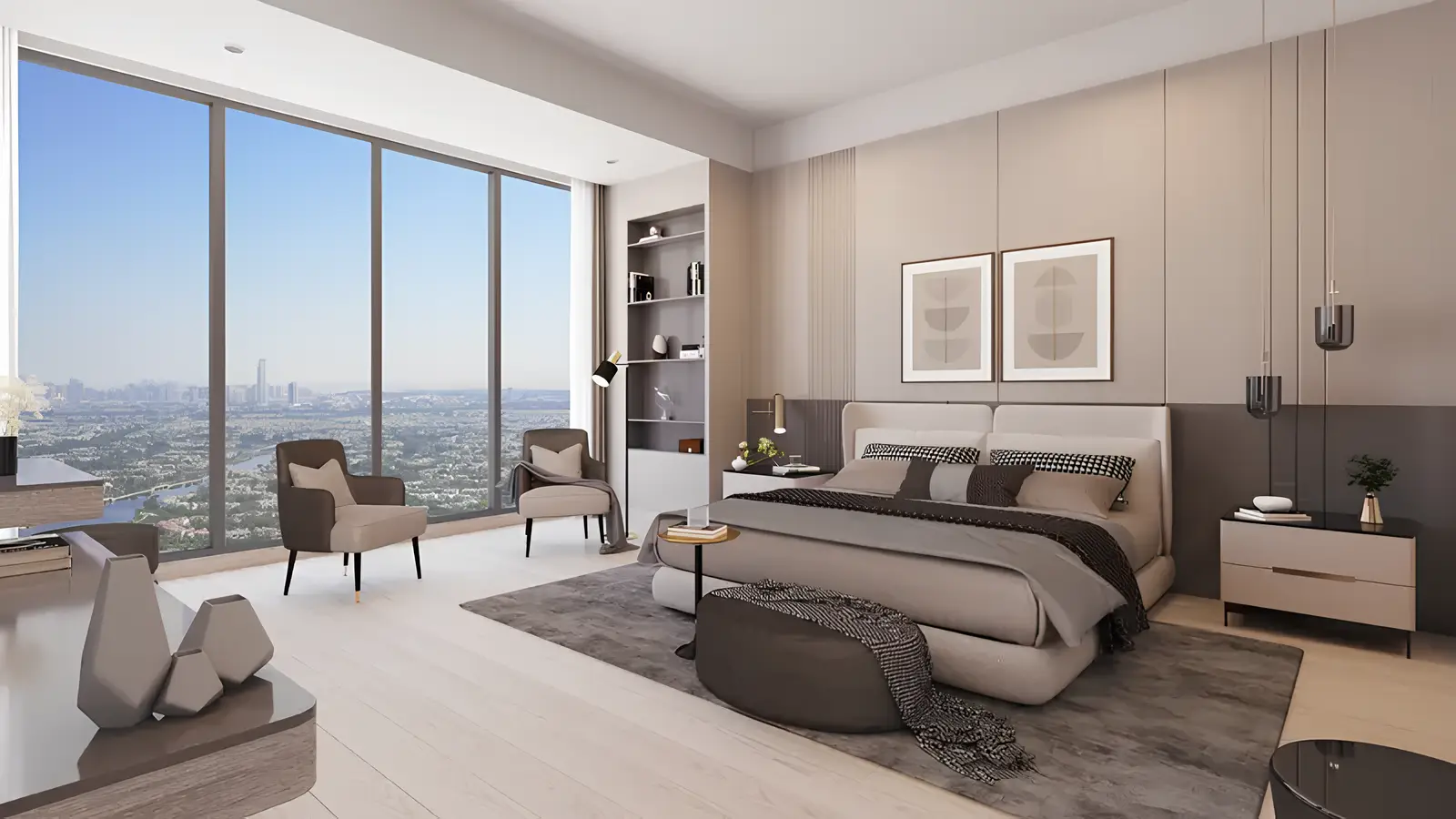
ME DO RE "Me Do Re Residential Tower" catalogue image in Jumeirah Lakes Towers. Project marketing illustration; confirm the exact home's condition, specification and availability separately.
Compare lake views with privacy and orientation
A lake-facing description can cover different levels of visibility. Inspect the outlook from the sofa, dining area and bedrooms. Check whether the view is open, partly obstructed or visible only from the balcony. A carefully framed advertisement may not represent how the outlook feels during ordinary use of the room.
Assess neighbouring windows and balconies at the same time. A pleasant view can coexist with limited privacy, while a less dramatic outlook may make the living room easier to use without curtains. Consider daylight and glare with the lights switched off where possible. Visit at another time if orientation is a significant reason for choosing the apartment.
Ask about adjacent plots or proposed works through reliable building and planning information. A current gap between towers should not be presented as a permanent view guarantee. The Dubai waterfront property checklist helps distinguish the actual outlook from the broader appeal of a water-oriented district.
Identify the layout that supports everyday living
Compare floor plans using dimensions rather than bedroom labels alone. Check the main living wall, dining space, kitchen preparation surface and storage. In an apartment where the owner expects to work remotely, the location of the desk and the route behind it can affect both comfort and privacy during calls.
Look closely at internal circulation. A long corridor may increase the advertised size without adding the kind of space you need. Door swings can limit furniture choices, and a room shown as a study may not provide the separation or dimensions you expect. Ask for measurements when a sales plan does not make these details clear.
Review how the apartment would function with guests or a second occupant. Bathroom access, bedroom separation and laundry placement can matter more than a decorative feature. Use one set of furniture assumptions across the shortlist, so that one attractive plan does not win simply because its illustration uses unusually small furniture.
Check tower management and maintenance
Observe the lift lobby, corridors and entrance during a viewing. Look at cleanliness, access control and the way residents or visitors move through the building. Ask how maintenance requests are reported and who follows up. A clear process is useful evidence of operating arrangements, although it does not replace inspection of current condition.
Request information about recent and planned common-area work where available. Ask whether important equipment has needed recurring repairs and how residents receive updates. Avoid assuming that a tower's age predicts its maintenance condition. An established building and a newly occupied one can present different questions that need different evidence.
For a buyer living overseas, investigate contractor access and the role of any property manager. Confirm whether a representative can arrange repairs, attend inspections and coordinate a tenant move-in. Agree how spending decisions and photographs of completed work will be reported. Good communication can reduce the practical burden of remote ownership.

ELLINGTON "Upper House" catalogue image in Jumeirah Lakes Towers. Project marketing illustration; confirm the exact home's condition, specification and availability separately.
Distinguish shared amenities from essential services
List the facilities you expect to use regularly and inspect them. Check gym equipment, pool access, changing areas and opening hours where those features are provided. A building's amenity list can help attract interest, but its value to you depends on availability, condition and rules at the time you would use it.
Consider whether the amenity package supports the intended tenant as well as the owner. A remote worker might appreciate a quiet shared workspace, while another resident may care more about reliable lifts and convenient access. Do not assign the same value to every facility simply because it appears in a photograph.
Ask which facilities are shared with other uses or require separate payment. Clarify visitor access and any booking limits. This is especially relevant in mixed-use buildings where a visual presentation may not explain allocation. Essential services such as security and maintenance deserve their own assessment rather than being overshadowed by leisure features.
Create a tower-specific cost schedule
Obtain the available service-charge evidence for the exact building and applicable period. Confirm the relevant area, inclusions and billing arrangements, and ask about outstanding amounts. Use the Dubai service-charge guide to structure the questions. A JLT-wide estimate is too broad to finalise an apartment budget.
Add separate lines for cooling and utilities, interior repairs, furnishing, management and financing where relevant. Ask whether equipment belongs to the owner and what maintenance history is available. If a cost is not yet confirmed, label it as an estimate and identify the person or supplier who can clarify it.
Keep initial cash requirements separate from annual running costs. A home that needs immediate work can have a different move-in budget from one in suitable condition, even if the asking prices are similar. Compare both options over the same period and include a reserve that remains available after completion.
Investigate the tenancy position of a resale
Ask whether the apartment is vacant or occupied and request the relevant tenancy information if it is rented. Understand what possession is proposed and which documents support that proposal. A buyer wanting to live in the home should not assume that purchasing an occupied apartment automatically means immediate availability for personal use.
For a landlord, review the existing rental arrangements before treating the advertised income as a basis for the purchase. Clarify the agreement period, included items and any owner obligations that affect costs. Seek suitable professional guidance for tenancy or legal questions rather than relying on a general community guide.
Inspect condition separately from tenancy status. An occupied apartment may require an agreed access appointment and a practical way to document included furniture or equipment. Keep any limits on inspection visible in your decision. When evidence is incomplete, the uncertainty belongs in the comparison instead of disappearing behind the appeal of an existing tenant.

DANUBE "Viewz by Danube" catalogue image in Jumeirah Lakes Towers. Project marketing illustration; confirm the exact home's condition, specification and availability separately.
Build rental assumptions around the right resident
Describe why a prospective resident would choose the apartment. The answer might involve a convenient workplace journey, a usable home office, an attractive outlook or a comfortable layout. These are different propositions, and they should lead you to different rental comparisons. A tower's broad reputation cannot establish the demand for your exact unit.
Request recent evidence from comparable homes, preferably within the same tower where practical. Match size, bedroom count, condition, furnishing and lease timing. Explain any important differences. Asking advertisements show the owner's intention; evidence of an agreed tenancy is more useful for evaluating what a similar home has actually achieved.
Calculate the operating result after costs and test a less favourable case. Include vacancy, management, maintenance and financing if applicable. If the purchase only works with uninterrupted occupancy at an optimistic rent, revisit the commitment. A sensible model makes uncertainty explicit and helps you judge resilience rather than promising a fixed return.
A comparison example for a commuter
Consider a buyer choosing between two JLT apartments with similar advertised areas. Home A has a striking lake view but a longer walk to the buyer's preferred transport connection. Home B has a less distinctive outlook, more practical storage and an entrance that simplifies the weekday journey. Neither is automatically superior for every buyer.
The commuter tests both routes at the relevant time and measures the usable rooms. They request current building costs and identify any immediate repair work. Home B may emerge as the better fit because its advantages are used every day, while Home A could remain attractive to someone who places more weight on the view.
Write your own version of this comparison using actual evidence. Include what you are prepared to trade away and what would change your decision. A strong rationale connects the chosen apartment to your purpose, rather than explaining the decision only through the community's popularity or the presentation of a single photograph.
Frequently asked questions about JLT apartments
Does a JLT address mean I can comfortably walk to the Metro? Verify the route from the exact tower and entrance. Include access out of the building and the station entrance you need. District-level proximity does not establish a convenient walking journey for every resident or every apartment.
Should I pay more for a lake view? Assess what is visible from normal living positions and how it affects privacy, light and room use. Compare the premium with your other requirements and total cash commitment. The value is personal and property-specific, and the current view should not be treated as permanently guaranteed.
Are older towers unsuitable? Building age is only one part of the assessment. Inspect the apartment, shared spaces, equipment and available maintenance information. Ask about planned work and current management arrangements. A comparison based on evidence is more useful than a blanket assumption about every established building.
Can JLT work for remote ownership? It may, if the particular home and management arrangements suit your plans. Establish inspection, repair approval, reporting and access procedures before buying. The location does not independently remove the need for reliable local representation or clear control over operating costs.
Your practical action plan
1. Record the tower and cluster for each shortlisted apartment.
2. Walk the actual route to the connections you will use.
3. Inspect the allocated parking bay, view, layout and shared areas.
4. Obtain tower-specific charges and possession information.
5. Compare matched rental evidence or household fit before negotiating.
Move from cluster selection to a property decision
Keep the tower, cluster, walking route, parking allocation, layout and ownership costs together in one file. Arrange a second viewing when a major question remains unresolved. Compare homes using the same intended resident and ownership period, so that the preferred option wins for reasons you can explain clearly.
Contact Property Gulf with your JLT search brief, including the destinations you travel to, layout requirements and available cash reserve. Ask for a shortlist that identifies both suitable towers and the evidence still required for each apartment. A productive search ends with an informed property decision, supported by the everyday experience and operating commitment of the exact home.