

The best Dubai neighbourhood for a buyer is the one that fits the people who will use the property, the journeys they will make, and the costs they can sustain. A famous address can still be inconvenient for a particular household. A newer district can be attractive while requiring patience about its surroundings. Location should be evaluated through daily life and evidence, not only through a map pin or a promised future.
This guide provides a practical way to compare neighbourhoods without claiming that one area is best for every investor. It helps you separate current conditions from plans, examine the specific building within a community, and create a shortlist that reflects your actual needs. The method works for personal use and investment, but the relevant criteria will differ.
What this guide covers
• Begin with the resident, not the district name
• Map the journeys that will happen every week
• Examine the building's position within the community
• Separate existing amenities from proposed amenities

TETR1S Tower architectural visualization from the existing Property Gulf library. The actual unit, specification and current project status require separate verification.
Begin with the resident, not the district name
Describe the likely resident in concrete terms. A family with school-age children, a professional working irregular hours, a couple spending part of the year abroad, and a long-term tenant may value different things. Write down the routines the location must support before comparing amenities or prestige.
For investors, this is a hypothesis about the intended tenant, not proof that demand exists. Ask for relevant evidence about comparable properties and leasing conditions. Avoid claiming that all residents of a nationality, profession, or income level behave the same way. The useful questions concern housing needs, travel patterns, space, affordability, and services.
Map the journeys that will happen every week
List work, school, childcare, shopping, healthcare, exercise, and regular social journeys. Rank them by frequency and importance. A convenient airport journey may matter to a frequent traveller, while a school route may dominate a family's weekday experience. The importance of each destination should come from the household, not the sales brochure.
Test routes at relevant times and by the transport modes actually intended. A distance measured on a map is not a reliable statement about door-to-door travel. Include building exit, parking, walking, transfers, and the return journey where relevant. Record the date and conditions of the test instead of presenting one trip as a permanent commute guarantee.
Examine the building's position within the community
A district can contain buildings with very different access, views, noise, and proximity to facilities. Identify the exact plot or building and the routes around it. A listing described as near a park or transport stop may still involve an inconvenient walk because of roads, access gates, construction, or the available pedestrian route.
Compare the actual entrance and unit orientation rather than the community's central map marker. Visit the immediate surroundings where possible. For off-plan property, request the site plan and distinguish confirmed access arrangements from illustrative landscaping. The specific location within the neighbourhood can be as important as the neighbourhood itself.

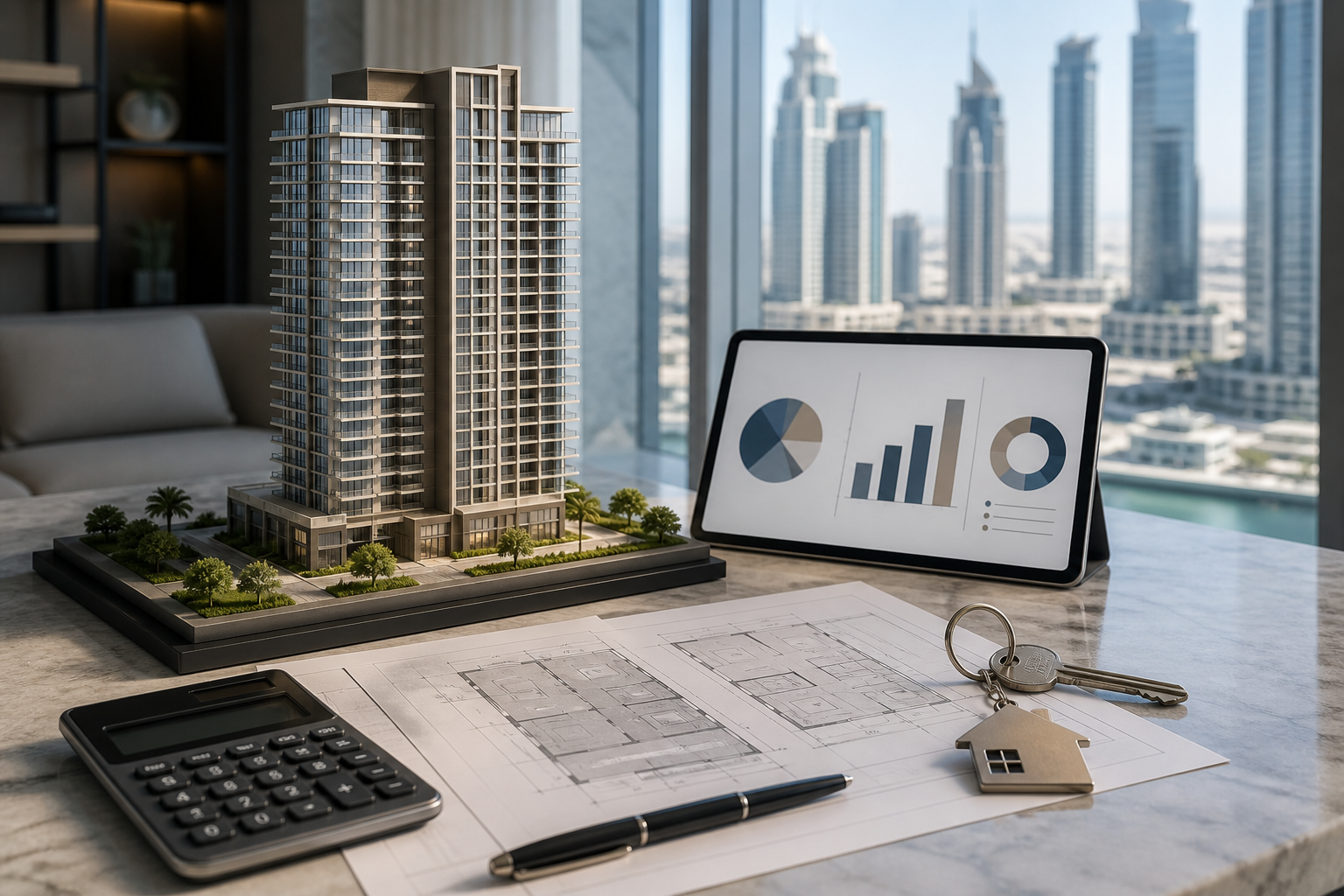
Illustrative property-planning scene from the Property Gulf media library; not a photograph of a unit offered for sale.
Separate existing amenities from proposed amenities
Create two lists: facilities available now and facilities described as planned. Include sources and dates for the planned items. Do not treat an announced school, retail centre, transport connection, or park as if it is already operating. Even a credible plan may not align with your intended occupancy date.
Ask whether the purchase still suits you if proposed facilities arrive later than expected. This does not imply they will be delayed; it tests the dependence of your decision on events outside your control. Buyers who need immediate convenience should give greater weight to current services that can be verified.
Assess everyday shopping and services
Check the practical access to groceries, pharmacies, routine healthcare, and other services you use frequently. Look beyond the presence of a retail icon on a plan. Consider opening hours, the route, parking, delivery access, and whether the available options fit your household's habits.
A community can have an impressive destination mall while still requiring a drive for ordinary errands from a particular building. Conversely, a smaller set of nearby services may be convenient for daily life. Evaluate the actual routine rather than counting facilities without considering how you will reach or use them.
Review education needs carefully
If schools or nurseries are important, investigate the institutions relevant to your family's curriculum, age group, budget, and transport needs. Proximity does not establish admission availability or suitability. Contact the provider directly for current information rather than relying on a property listing's general description.
Test the school journey at the relevant time and consider how it interacts with work. A location that looks balanced on a map may create two difficult trips each day. Families planning for future school years should keep assumptions explicit because availability, preferences, and circumstances can change during the ownership period.
Observe noise and activity at different times
Visit during a weekday and an evening if possible. Listen for traffic, nearby construction, deliveries, commercial activity, and building equipment. Observe the approach to the entrance as well as the apartment itself. A quiet showroom or a short daytime viewing may not represent the experience of living there.
Noise sensitivity varies. The aim is not to label a lively area as bad or a quiet area as good for everyone. It is to understand whether the specific unit fits the intended resident. For off-plan property, assess the surrounding uses and acknowledge what cannot yet be verified from inside the future apartment.
Illustrative buyer-comparison scene from the Property Gulf media library.
Consider construction around the property
An established district can still have active development nearby. Identify neighbouring plots and current works, and ask what information is available about their intended use. Construction can affect access, views, noise, and the immediate environment. Avoid assuming that an empty plot will remain empty or that every planned structure will be completed on a particular date.
Record the distinction between official information, developer statements, and speculation. A possible future obstruction should be investigated, but unsupported rumours should not be presented as facts. If an unobstructed view is central to the purchase, ask for professional guidance on the evidence and contractual representations relevant to that claim.
Assess transport according to actual use
A buyer planning to drive should inspect parking allocation, visitor arrangements, access roads, and the journey to major destinations. A buyer relying on public transport should test the complete route on foot and by the relevant services. The same location can work well for one transport pattern and poorly for another.
Do not convert a future transport announcement into a current accessibility claim. Check official transport information for services that operate now and make clear when an improvement is proposed. A property should be evaluated against your real needs during the period you expect to own or occupy it.
Compare housing options within the location
A neighbourhood's reputation does not tell you which unit type will suit your budget and use. Compare layouts, building age, maintenance, facilities, service charges, parking, and availability. A smaller apartment in a preferred area may be a better fit than a larger one elsewhere, or the opposite may be true.
Make the trade-off explicit. If you choose location over internal space, identify the minimum workable layout. If you choose more space farther away, quantify the practical effect on regular journeys. This prevents a vague preference from becoming an expensive compromise that only becomes obvious after moving.
Look at ownership costs alongside location benefits
Purchase price is only part of the location decision. Building charges, transport spending, parking, management, and unit upkeep can affect the total cost. Some expenses belong to the building rather than the neighbourhood, so keep the levels separate. Ask for property-specific information where available.
For approved building charges, the DLD Service Charge Index can support verification. Do not use a community average as a confirmed charge for a specific apartment. A location that fits the headline purchase budget may still be uncomfortable if ongoing costs and travel requirements are ignored.

JAD 288 architectural visualization from the existing Property Gulf library. Shown as an example of project marketing imagery, not proof of delivered condition or availability.
Use evidence when assessing rental demand
Investors should ask which comparable units are renting, on what terms, and how recently the evidence was collected. Distinguish advertised rents from completed agreements. Consider furnishing, condition, layout, building quality, and lease duration when assessing comparability. A broad statement that an area is popular does not establish a specific unit's income.
Ask what might make the property harder to lease. Examples include an awkward layout, limited access, a less practical view premium, or competition from similar units. These are questions for investigation, not automatic conclusions. A useful investment brief explains both the demand case and the factors that could weaken it.
Match the area's maturity to your holding period
A buyer intending to occupy immediately may value established services more heavily than a buyer with a longer horizon. An emerging location can offer a different proposition, but future improvement remains uncertain in timing and effect. Do not use a long-term story to justify a short-term funding obligation.
Ask whether you can hold the property through the period your thesis requires. If you may need to sell sooner, examine the implications without assuming a ready buyer or a higher price. The investment horizon should be a realistic financial commitment, not merely the duration needed for the sales narrative to work.
Build a location scorecard with meaningful criteria
Choose a small set of criteria that reflects the intended resident: commute, schools, daily services, transport, noise, outdoor space, layout options, and ownership cost. Weight them according to actual importance. Keep essential constraints separate so an unacceptable commute cannot be cancelled out by attractive amenities.
Use written reasons beside scores. A score of four out of five is not useful if nobody knows what evidence supports it. Mark unverified criteria as unknown. The scorecard should guide a focused conversation and site visit, not create the illusion that neighbourhood quality can be reduced to a universal investment ranking.
Plan a productive area visit
Group nearby properties into a route and allow time outside the apartments. Walk the streets you would use, visit routine services, inspect parking, and test the relevant journey. Take dated notes and photographs where permitted. Avoid visiting so many units that the buildings and locations become difficult to distinguish.
After each visit, record the strongest benefit, largest compromise, and unresolved question. Review the notes before the next viewing rather than relying on memory at the end of a long day. An advisor can then refine the shortlist based on observed preferences instead of continuing to send loosely related options.
Revisit the shortlist after testing the routine
After the first area visit, review which assumptions changed. Perhaps a route was less convenient than expected, a smaller building felt more practical, or nearby services mattered more than a distant landmark. Update the brief before viewing additional properties. Continuing with the original criteria after learning something important wastes time and can make the search unnecessarily confusing.
Ask each household decision-maker to record priorities separately before discussing them together. This can reveal a genuine disagreement about location, space, or travel that no property brochure will resolve. Agree the trade-offs explicitly so the advisor is not trying to satisfy contradictory instructions without knowing which requirement matters most.
For an investment purchase, review the tenant hypothesis with the same discipline. If the unit would only suit a narrow use case, ask whether the available demand evidence supports it. A distinctive property can be attractive, but its appeal should be understood rather than assumed. Keep the conclusion tied to the particular building and apartment instead of extending it to an entire neighbourhood.
Keep a decision record after every visit
Write a short note immediately after each neighbourhood visit while the details are still clear. Separate what you observed from what someone told you and from what remains an assumption. Record the day, approximate time, travel route, and any unusual circumstance that may have affected your impression. A quiet holiday morning should not automatically represent an ordinary working day. Compare these notes against the same household priorities rather than relying on the last place you visited. If two areas remain close, arrange a targeted follow-up to answer the unresolved question, such as an evening journey or access to the facilities you would actually use.
Frequently asked questions
Which Dubai neighbourhood is best for investment?
There is no universal answer. The appropriate choice depends on budget, unit, rent evidence, operating costs, financing, and holding period. Compare specific properties and explain the assumptions. A neighbourhood name alone does not establish a return or guarantee demand.
Should I buy near a planned transport connection?
Consider the official information and distinguish future plans from current service. Ask whether the property meets your needs before the improvement is available. Do not base affordability or a short-term exit entirely on an expected infrastructure benefit.
Is an established area always preferable?
Not for every buyer. Established services can reduce some uncertainty, while an evolving area may suit a different timeline and budget. Examine the actual property, costs, and surrounding conditions. The right choice is the one that fits your requirements and risk tolerance.
Your practical action plan
1. Rank your essential journeys and household needs.
2. Compare current services with proposed future changes.
3. Visit the actual building location at relevant times.
4. Reconcile operating costs and the intended resident profile.
5. Revisit the strongest options to resolve specific uncertainties.
Turn a location preference into a usable brief
Start with the resident's routine, test the specific building position, separate current facts from plans, and compare total costs. A disciplined location review makes property recommendations more relevant and reduces the chance of choosing an address that looks compelling but functions poorly for you.
Explore the Property Gulf knowledge hub and request a neighbourhood comparison. Share your regular destinations, preferred unit size, budget, occupancy date, and transport needs. Ask for a shortlist that explains why each location fits and what compromise comes with it.