

The practical difference between ready and off-plan property in Dubai is when you can inspect, use, and potentially earn income from the home. A ready unit allows a more direct examination of the building and its surroundings. An off-plan purchase requires you to assess a future product through documents, project evidence, and contractual commitments. Neither category is automatically the better investment.
The choice should follow your intended move-in date, available cash, tolerance for uncertainty, and ability to hold the property. This guide offers a structured comparison without assuming that future price growth or rental income is guaranteed. It focuses on deciding which type of purchase belongs on your shortlist before comparing individual projects.
What this guide covers
Define what the property must do for you
What a ready property lets you verify
What an off-plan purchase requires you to assess
Compare the funding timeline on equal terms
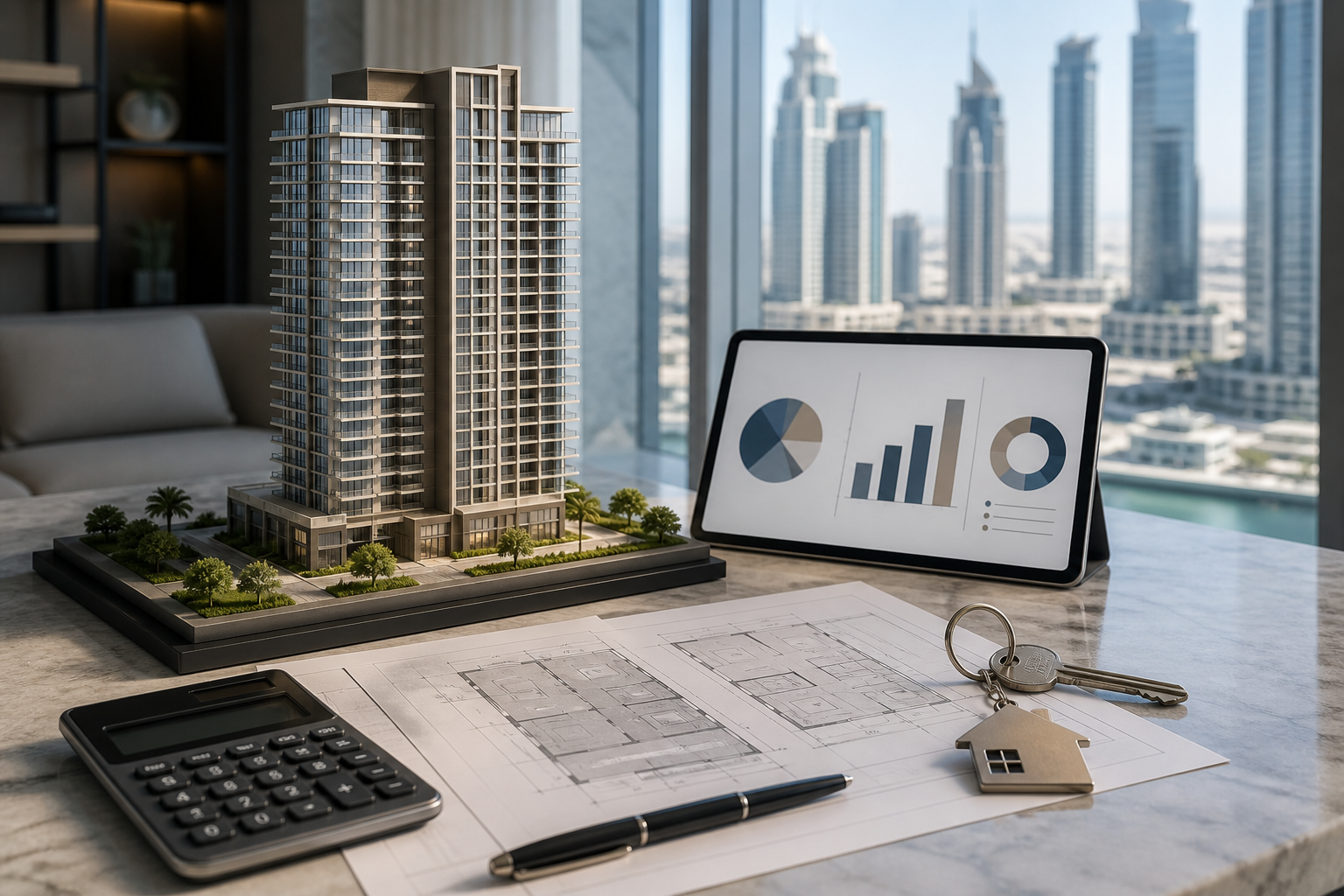
Illustrative buyer-comparison scene from the Property Gulf media library.
Define what the property must do for you
Start with a sentence describing the purchase in operational terms. A family might need a usable home before the next school term. An overseas investor might want rental income soon after acquisition. Another buyer might be accumulating funds over several years and seeking a future residence. These are different requirements, even when all three buyers have the same headline budget.
Assign a latest acceptable occupancy date and an earliest date at which you need income. If either is close, a property that is not yet available for occupation may fail your requirements before its design or payment plan is considered. If your timeline is flexible, you can assess construction-stage opportunities without pretending their timing is equivalent to a completed home.
What a ready property lets you verify
In a completed building, you can inspect the actual apartment, common areas, access route, parking, lift arrangements, and surrounding streets. You can test whether the floor plan works with furniture, observe noise, and investigate maintenance. This reduces some uncertainty about the physical product, although it does not remove the need for title, contractual, financial, or technical checks.
A viewing should include the route from the allocated parking space to the apartment and the facilities a resident would actually use. Visit at more than one time if possible. A quiet midday inspection can miss peak traffic or evening activity. Ask about current occupation and access arrangements; a completed apartment is not necessarily vacant or immediately available to its purchaser.
What an off-plan purchase requires you to assess
An off-plan buyer relies more heavily on the unit schedule, approved plans, specifications, project registration, construction evidence, and sale agreement. The brochure may show a polished setting that will take time to develop. Distinguish the individual building's expected delivery from the delivery of surrounding facilities, roads, landscaping, and neighbouring phases.
Ask for the exact unit orientation, floor, dimensions, balcony arrangement, furnishing specification, and payment schedule. Identify where the contract permits changes and seek qualified advice where the wording is unclear. A show apartment can demonstrate a design concept, but you should confirm which fittings and finishes form part of the property being purchased.

JAD 288 architectural visualization from the existing Property Gulf library. Shown as an example of project marketing imagery, not proof of delivered condition or availability.
Compare the funding timeline on equal terms
A ready purchase may concentrate cash requirements near completion of the transaction, while an off-plan purchase may spread price payments across construction. However, neither pattern should be assumed without unit-specific terms. Financing, seller arrangements, developer conditions, and the stage of construction can materially affect the schedule. Obtain written figures for each option.
Build a common comparison using immediate cash, twelve-month cash, largest future payment, transaction expenses, and reserve requirements. For a completed home, include any refurbishment and setup spending. For an unfinished home, include the expected completion payment and an allowance for the period before occupancy. Comparing purchase prices alone can disguise a funding mismatch.
Separate ownership from rental readiness
A ready apartment can still require cleaning, repairs, furnishing, documentation, photography, and marketing before it produces rent. An occupied apartment may have an existing tenancy that must be reviewed. Ask for the actual tenancy documents, relevant payment records, and current management arrangements rather than assuming an advertised annual rent is immediately available to a new owner.
An off-plan home has an additional gap before these steps can begin. Your model should distinguish expected construction completion, inspection and correction, possession, setup, tenant search, and the first receipt of rent. Do not compress all of these into one optimistic handover date. Timing differences can matter more than a small difference in purchase price.
Inspect operating costs at the building level
Two apartments in the same community can have different operating costs because their buildings have different facilities, management arrangements, and maintenance needs. For a ready building, request recent service-charge information, relevant statements, and clarification of outstanding amounts. For an unfinished building, identify which figures are estimates and what evidence supports them.
The DLD Service Charge Index is an official starting point for approved charges. Select the relevant project and year rather than applying a community-wide assumption. Budget separately for expenses that may not be included in the quoted charge, such as unit repairs, leasing services, furnishing replacement, and any applicable financing costs.
Think about the market you will enter at resale
Liquidity is the ability to find a suitable buyer at acceptable terms within your required time, not a promise that a property can always be sold quickly. For a completed unit, comparable available listings and recorded transactions may provide context, but they do not guarantee your outcome. The asking price of a neighbouring apartment is not proof of a completed sale.
For an off-plan unit, investigate the contractual route for assignment or resale and consider the competing inventory that may exist at your intended exit. Other buyers in the same project may also want to sell. Your plan should remain workable if you need to hold through completion, rather than depending entirely on a profitable early transfer.

TETR1S Tower architectural visualization from the existing Property Gulf library. The actual unit, specification and current project status require separate verification.
Understand the difference between defects and delivery uncertainty
A completed property can have defects or deferred maintenance. An unfinished property can have specification, timing, and execution uncertainty. These require different investigation methods. An independent inspection helps assess the condition of a ready home; a project review and careful contract examination help assess a construction-stage purchase. Neither replaces the other.
Ask who will handle defect reporting, what process applies, and what documents establish the relevant obligations. Avoid assuming that a famous developer name, a recent completion date, or a refurbished interior removes technical risk. Equally, avoid treating an older property as automatically inferior. Good maintenance records and practical layouts may be more relevant than the age label.
Compare location as it exists and as it is proposed
For each candidate, describe the current surroundings in one column and proposed changes in another. Existing shops, school routes, transport access, construction activity, and pedestrian conditions belong in the first column. Announced future infrastructure belongs in the second, with a source and a clear indication of uncertainty about timing and practical benefit.
This distinction matters in both ready and off-plan purchases. A completed building can sit in an evolving district, while a new project can be surrounded by established amenities. Avoid using the maturity of the apartment as a substitute for examining the neighbourhood. Test the journeys and services relevant to the actual residents you expect.
Evaluate rent and growth as separate assumptions
Rental income and capital appreciation are different parts of an investment case. A property may have an attractive rental proposition without meeting your desired resale timeline, or it may be marketed around future growth while offering uncertain near-term cash flow. Write down the evidence supporting each assumption separately.
Use conservative operating scenarios and do not require appreciation to make routine payments affordable. If the purchase only works when the resale price rises substantially, identify that dependency explicitly. A transparent comparison might still favour the property, but it should not disguise a speculative assumption as a current fact. Seek financial advice where the commitment materially affects your wider finances.
Choose the right evidence for each category
For ready property, request documents that establish the actual unit, ownership, occupation, running costs, and condition. For off-plan property, request project verification, the unit-specific contract package, construction information, specifications, and the payment timetable. Keep a list of missing evidence instead of treating an attractive sales presentation as a completed review.
Consult the official sale-registration service for the relevant completed-property transaction route, and ask the advisor to confirm the process applicable to your purchase. The correct workflow depends on the transaction, so do not copy a friend's checklist without checking whether the circumstances match.

Illustrative property-planning scene from the Property Gulf media library; not a photograph of a unit offered for sale.
Use three buyer scenarios to clarify the decision
Consider a relocating household that needs accommodation within three months. An unfinished home may be a poor primary solution even if its future layout is ideal. The household would need a separate housing plan and must account for that cost. A completed, vacant property with verified possession arrangements may fit the immediate requirement more directly.
Now consider a buyer whose income is strong but whose initial cash is limited. A staged purchase might match savings over time, provided the completion balance is realistically funded. Finally, consider an investor seeking immediate net income. That buyer should examine actual rent, occupation, expenses, and financing rather than selecting solely by the newest launch or most impressive rendering.
Build a decision matrix without false precision
Use a small set of criteria: timing, cash requirement, physical certainty, operating-cost evidence, location fit, and exit flexibility. Mark each property as suitable, uncertain, or unsuitable for each criterion. A critical failure, such as missing the required move-in date, should not disappear because the property scores well on amenities.
You can add weights if they help organize discussion, but a numerical score is not an objective investment rating. Record why a criterion received its assessment and which evidence remains missing. The strongest output is a short explanation of the trade-offs, supported by documents, rather than a highly precise percentage that hides subjective judgement.
Questions worth asking before the final shortlist
For ready units, ask whether the property is vacant, how access and possession will be handled, what work is required, and which charges remain outstanding. For off-plan units, ask what triggers each payment, how completion is defined, and what happens if your circumstances change. Ask both sellers and developers for written answers where those answers affect your decision.
Ask your advisor to explain the weakest feature of each recommendation. A credible shortlist should acknowledge compromises: a less convenient commute, greater completion funding pressure, older building systems, or a more uncertain leasing timeline. If every option is described as ideal for every buyer, the comparison is not yet specific enough.
Compare the cost of waiting
If you choose an unfinished home for personal occupation, include the accommodation you will use until it becomes available. Existing rent, moving costs, storage, and the possibility of an additional temporary move belong in the personal budget. These expenses do not necessarily make off-plan unsuitable, but excluding them can make the comparison with a ready home misleading.
For an investor, the waiting period has a different meaning. Capital may be committed before rental operations begin, and further instalments may fall due during that period. Compare the timing of all cash flows rather than treating a future annual rent as if it starts immediately. Keep any opportunity-cost calculation transparent, including the assumed alternative use of funds.
Also consider the value of flexibility. A buyer with an uncertain work location or household size may prefer to postpone a highly specific housing choice, while another may value securing a future layout. This is a personal decision that a simple yield comparison cannot resolve. Write down which future changes would make the chosen property less suitable and whether you could still comfortably hold it.
Frequently asked questions
Is ready property always safer?
No. Physical inspection reduces some uncertainty, but ownership, tenancy, maintenance, price, and financing risks still require review. A ready apartment with unresolved documents or substantial repairs may be a worse fit than a well-understood off-plan purchase. Safety depends on evidence and the buyer's circumstances, not the category name.
Is off-plan property always cheaper?
No. Prices reflect the specific project, unit, location, terms, and market conditions. Compare equivalent properties and total costs. A low initial payment is not the same as a low total price, and an advertised launch price does not establish value without a meaningful comparison.
Can I buy off-plan while planning to move sooner?
Potentially, but you need a separate accommodation plan and sufficient funding for both obligations. Do not rely on early delivery. Use the contractual timeline, obtain professional advice on its implications, and allow for the practical period between completion, inspection, corrections, and a usable home.
Your practical action plan
Set your required occupancy and income dates.
Check actual condition for ready homes and project evidence for off-plan homes.
Compare cash schedules including the cost of waiting.
Test operating costs and resale assumptions separately.
Shortlist only properties that fit your timeline and funding.
Choose the category that fits your actual life
The best starting point is the outcome you need, followed by the cash schedule and evidence available. Once the category fits, compare individual units carefully. A sensible choice for another investor may be unsuitable for your household, business, or time horizon. Keep the decision tied to your requirements throughout the sales process.
Explore Property Gulf's Dubai buying overview and off-plan checks, then request a ready-versus-off-plan shortlist. Provide your move-in deadline, available cash, financing expectations, and intended use so the comparison starts with properties you can realistically buy and hold.